




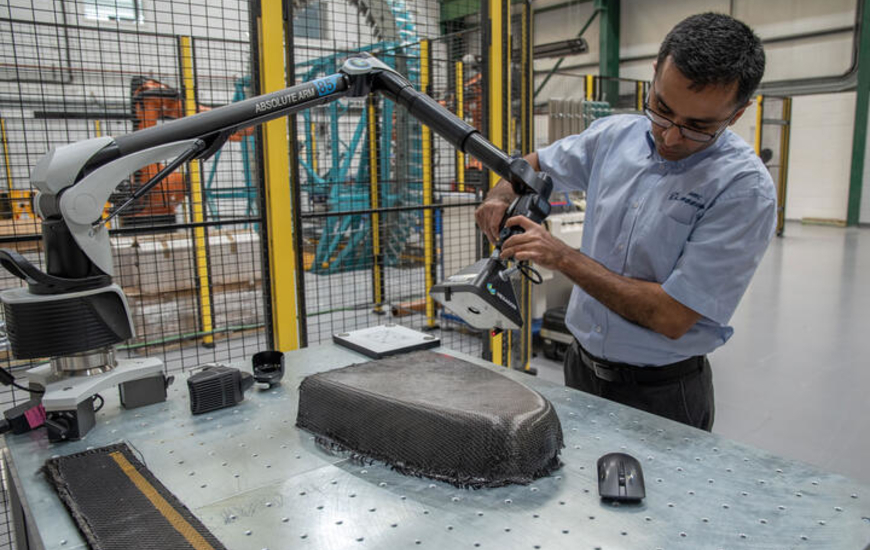


A vision inspection system using 3D modelling could save composite manufacturers valuable time and money by eliminating the manual inspection process of composite materials and parts, according to researchers at the University of Sheffield Advanced Manufacturing Research Centre (AMRC).
“Quality checks during the lay-up process are vital but can take 70-per-cent or more of total machine time,” said Zeeshan Qureshi, Lead Research Engineer on the Design Analysis and Composite Automation team at the AMRC Composite Centre.
“It is a huge cost to our partners so we’re investigating automated in-process inspection systems that could help significantly decrease, or even eliminate entirely, manual inspection in order for them to achieve higher productivity in their factories.”
Composite components are made by layering plies of unidirectional fibres or woven fabrics, which are then cured to produce a final solid part. The strength of the part is dependent on the correct alignment of the fibres from which it is made; fibres which are laid incorrectly can result in a range of defects that affect the structural integrity of the final part.
Detecting such defects, from gaps and overlaps to the presence of foreign objects and debris, at the relatively early lay-up stage of production is much more efficient and cost effective than identifying unacceptable weak points in the material once it is part of a completed component.
Zeeshan said the Composite Centre researched what systems were being successfully employed in related applications which identified the capabilities of the Absolute Arm and its laser scanner options, products developed by Hexagon’s Manufacturing Intelligence division.
“We discovered that Hexagon have developed a composite inspection system specially for measuring fibre orientations, which we believed could be a potential candidate for solving some of our inspection problems. They were quickly able to bring one such system to the AMRC to perform a case study – an Absolute Arm with RS5 Laser Scanner and a Vision System 3D,” said Zeeshan.
The Vision System 3D is a camera-based sensor that can accurately detect the orientation of composite fibres using pixel based algorithms. The system uses a metrological Absolute Arm for position referencing and, combined with scans made using the arm’s laser scanner and camera functionalities, this fibre orientation data can be mapped onto a three-dimensional model of the part being inspected using the dedicated Explorer 3D software platform.
-

-
26 August 2020