




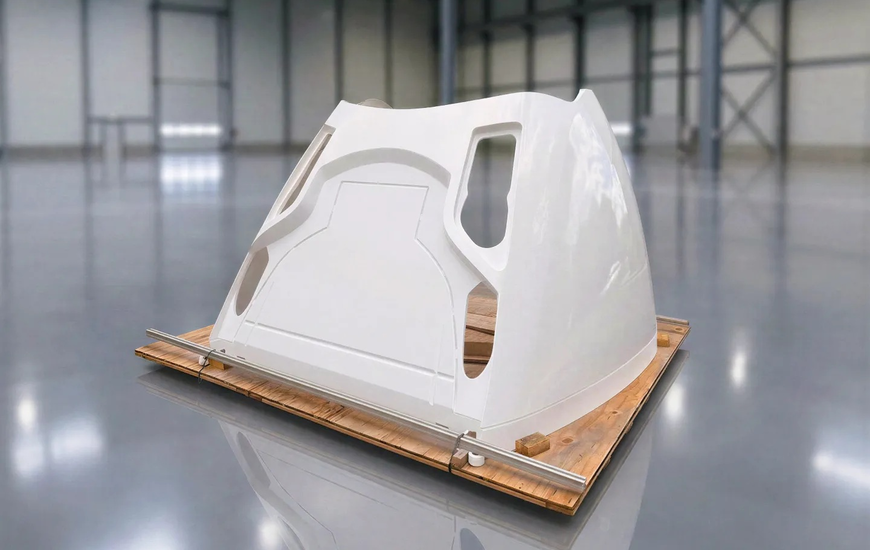


The 3D-FiberTrain research project has demonstrated a new manufacturing route combining large-format additive manufacturing with continuous-fibre reinforcement for large and highly loaded railway components.
The process first uses granule-fed extrusion printing to manufacture the thermoplastic geometry without dedicated moulds. An automated 3D tape-laying system then adds continuous-fibre reinforcement selectively along the main load paths, followed by CNC machining to achieve the required dimensional accuracy.
The technology was validated on two components for the Siemens Mobility Velaro MultiSystem, operated by Deutsche Bahn as the ICE 3neo: a front skirt and a nose section. The demonstrators used glass fibre-reinforced polycarbonate modified to comply with railway fire-safety requirements.
The fully thermoplastic manufacturing chain is also designed with material recycling in mind. By eliminating dedicated tooling and applying continuous fibres only where structurally required, the technology could reduce manufacturing costs and lead times, particularly for small and medium production runs.
The project involved Hörmann Vehicle Engineering, Fraunhofer IWU, Fraunhofer IMWS and Lakowa, with Siemens Mobility participating as an associated partner.
-

-
27 August 2026