




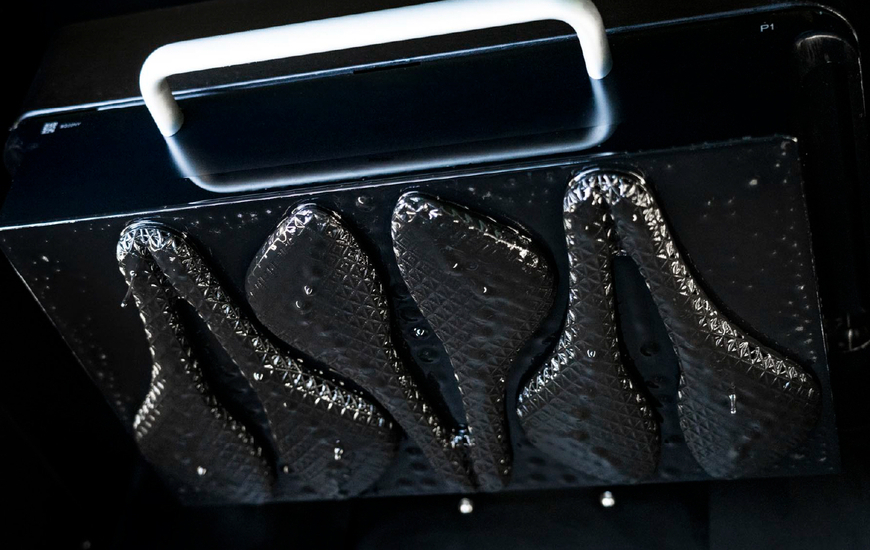


Carbon has surpassed one million cycling saddles manufactured using its additive manufacturing platform, marking a significant milestone for the use of 3D printing in high-performance sporting products.
The saddles are manufactured using Digital Light Synthesis™ (DLS™), which enables programmable lattice structures with different mechanical responses across individual areas of the component. Cushioning, support and load response can therefore be digitally tuned for each application.
Carbon now works with 11 saddle brands worldwide and has more than 60 models in production. The milestone demonstrates how additive manufacturing is moving beyond prototyping and low-volume applications towards end-use components produced at meaningful scale.
One of the most advanced applications is rider-specific customisation. Selle Italia, for example, recently introduced its Unica saddle, manufactured by Carbon production partner Prototek using EPU 46 elastomer. Pressure-mapping data from the individual cyclist is used to engineer a unique internal lattice structure.
A similar approach is used by fizik through its One-to-One programme, with saddles tailored to individual pressure profiles and riding positions. The technology is also being used at the highest level of professional cycling: at the 2026 Tour de France, Tadej Pogačar raced on a customised Argo Adaptive saddle manufactured using Carbon DLS.
Growth is supported by Carbon’s global manufacturing ecosystem of more than 40 production partners across 11 countries, allowing brands to move from product development into commercial manufacturing closer to their target markets.
The milestone comes ahead of Formnext 2026 in Frankfurt, where Carbon will showcase applications already in production across cycling, custom footwear, protective equipment, mobility seating, medtech, automotive and industrial markets.
The cycling saddle programme therefore demonstrates how additively manufactured lattice structures can become an industrial solution for scalable and customised end-use products, combining digitally programmed mechanical performance with production flexibility.
-

-
22 October 2026