




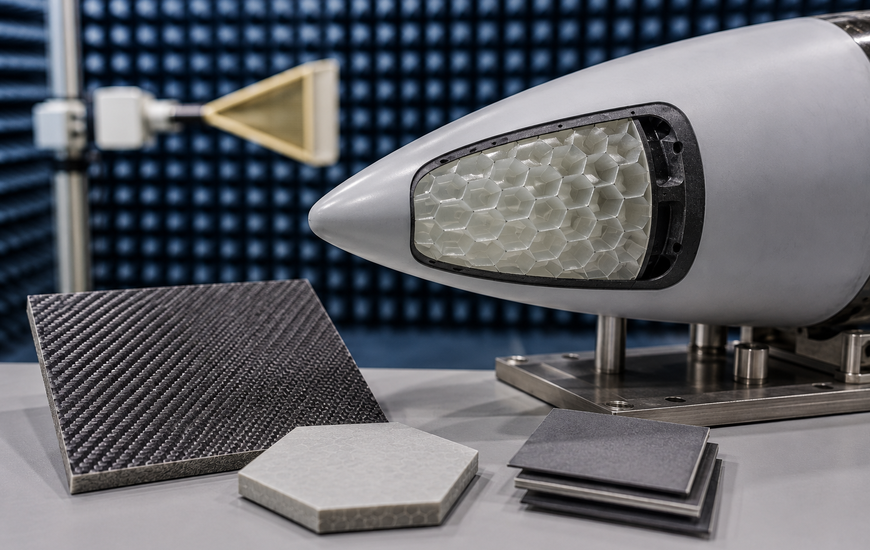


Protecting antennas and communication systems from extreme temperatures without blocking electromagnetic signals is a major challenge for hypersonic vehicles. New research investigates silicon nitride (Si₃N₄)-based ceramic composites designed for these demanding environments.
Researchers at Sun Yat-sen University examined the relationship between composition, microstructure and interfaces to understand how these parameters affect both mechanical properties and electromagnetic wave transparency.
The materials could be used for radomes and antenna windows, which must protect sensitive equipment and retain structural integrity at high temperatures while allowing radio-frequency signals to pass through.
The study highlights interface engineering as a potential route to balance these competing requirements and develop a new generation of high-temperature, wave-transparent composites for future hypersonic applications.
-

-
25 August 2026