




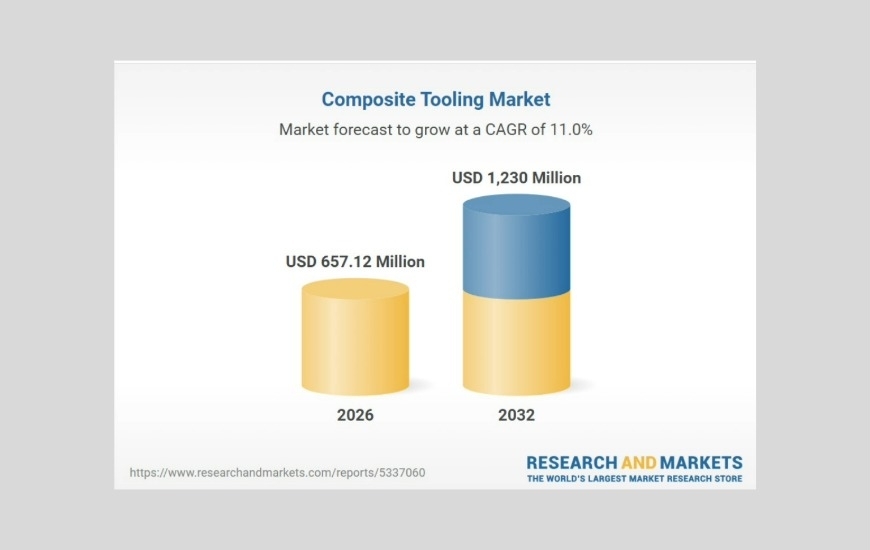


The global composite tooling market is projected to reach $657.12 million in 2026 and grow to $1.23 billion by 2032, representing an 11% compound annual growth rate. This is according to the “Composite Tooling Market Size, Share & Forecast to 2032” analysis by Research and Markets, which highlights an ongoing transformation in the technologies used to manufacture composite parts.
Composite tooling includes moulds, fixtures, mandrels, trim tools and lay-up aids used across aerospace, defence, automotive, wind energy, marine, rail and industrial applications. Demand is being driven by the growing adoption of lightweight structures, together with the need for repeatable quality, shorter production cycles and tooling compatible with different manufacturing technologies, from autoclave and out-of-autoclave processing to resin infusion, compression moulding and Automated Fiber Placement.
According to the analysis, one of the most significant changes is the growing role of additive manufacturing, increasingly used for master patterns, sacrificial cores, jigs, fixtures and large-format tooling. Additive processes can reduce manufacturing lead times while enabling geometries that can be difficult to achieve using conventional technologies.
At the same time, the expansion of out-of-autoclave manufacturing is placing greater emphasis on vacuum integrity, thermal uniformity and tool surface quality. The growth of thermoplastic composites is also changing tooling requirements, as higher processing temperatures and rapid heating and cooling cycles demand more effective thermal management.
Another factor reshaping the sector is artificial intelligence. According to Research and Markets, AI-based technologies can support generative design, simulation, defect prediction and manufacturing control. Data generated by thermocouples, pressure sensors, vacuum systems and automated equipment can be analysed to identify anomalies, tool wear, leaks or dimensional drift before they result in defective parts.
Sustainability and durability are also becoming increasingly important, encouraging the development of repairable and reusable tooling, lower-waste manufacturing, longer operating life and reduced energy consumption during cure cycles.
Geographically, Asia-Pacific, North America and Europe represent major centres of composite tooling activity. In Italy, the analysis highlights opportunities associated with the country’s capabilities in automotive, marine, aerospace and industrial manufacturing.
Composite tooling is therefore evolving from production hardware into an increasingly strategic and digital element of composite manufacturing, where precision, automation, monitoring and durability can directly influence productivity, quality and cost.
-

-
16 September 2026