




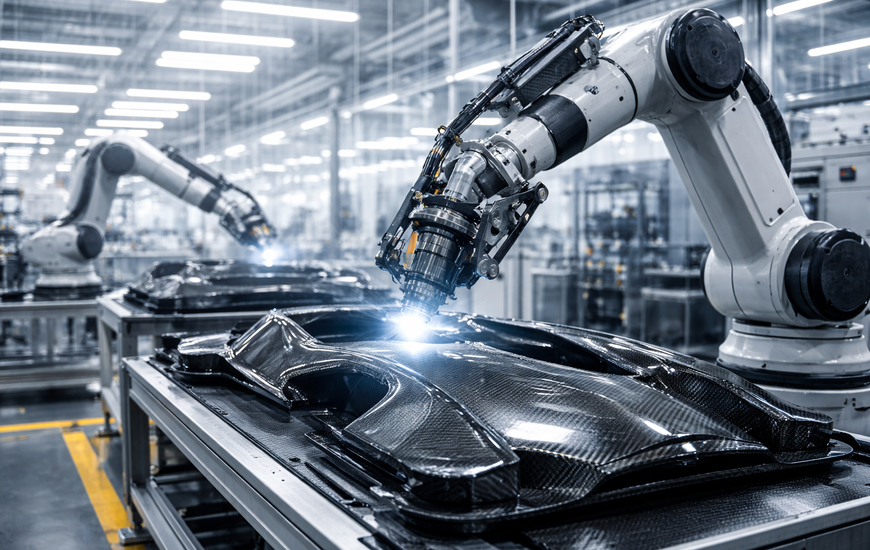


For decades, carbon fiber has been the iconic material of supercars and motorsport. Its unique combination of lightness, stiffness and strength has enabled engineers to design chassis, body panels and structural components capable of improving performance, safety and vehicle dynamics. Today, however, the automotive sector is undergoing a significant transformation: the goal is no longer only to produce high-performance carbon fiber components, but to manufacture them at increasingly higher volumes.
Traditionally, carbon fiber processing has been associated with relatively slow and craftsmanship-oriented manufacturing methods such as autoclave molding. In this process, resin-impregnated fiber fabrics are cured under high temperature and pressure, producing parts with exceptional mechanical properties but with cycle times that limit large-scale production.
In recent years the industry has begun developing alternative technologies designed to increase productivity. These include press molding with prepreg materials and processes based on compression-molded composites such as SMC (Sheet Moulding Compound), which allow faster production cycles and improved component repeatability. Such technologies make it possible to manufacture semi-structural and structural carbon fiber parts with quality standards compatible with automotive manufacturing.
The shift toward so-called high-volume carbon fiber is also driven by the rapid growth of electric vehicles. Battery systems significantly increase vehicle mass, making lightweight materials essential to offset this weight. In this context, carbon fiber reinforced polymers - commonly referred to as CFRP - provide an effective solution for reducing structural weight while maintaining high stiffness and crash performance.
At the same time, component manufacturers are investing in more automated and integrated industrial processes capable of combining design, engineering and serial production. The objective is to transfer technologies originally developed for hypercars and racing prototypes to sports vehicles produced in larger numbers.
Several factors will be crucial in accelerating this transition. First, the development of faster and more scalable manufacturing processes capable of reducing cycle times while maintaining high component quality. Second, closer integration between automotive manufacturers and composite material suppliers, enabling structural architectures to be optimized from the earliest vehicle design stages. Another key element is the automation of production lines and the adoption of digital process monitoring technologies, which are essential for ensuring repeatability and competitive costs.
Finally, collaboration between industry and research institutions can drive the development of new resins, fibers and recycling technologies, expanding the range of composite applications while improving sustainability. If these conditions continue to evolve, carbon fiber may move beyond its traditional niche in hypercars and become a central material in the next generation of high-performance mobility.
The editorial staff
-

-
04 March 2026