




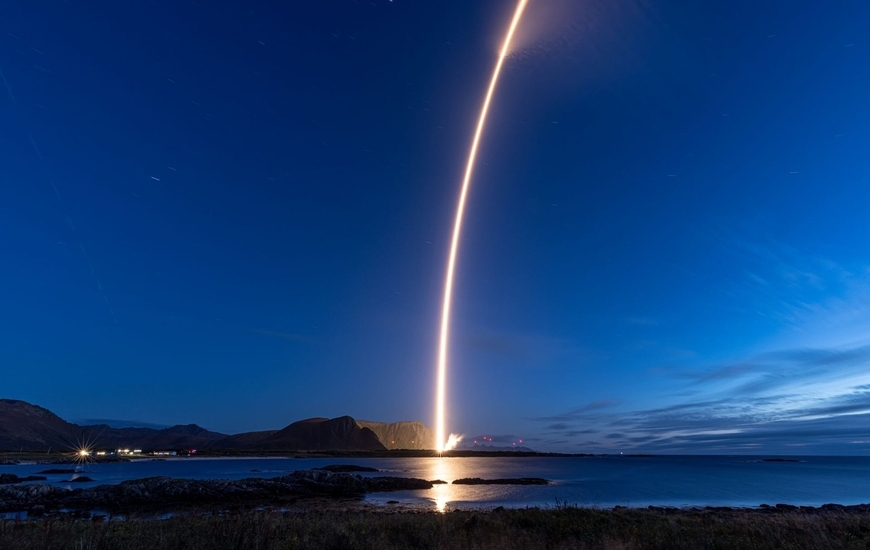


Isar Aerospace has reached orbit for the first time with its Spectrum launch vehicle, which lifted off from Andøya Spaceport in Norway on 5 September. The “Onward and Upward” mission, only Spectrum’s second flight, successfully deployed payloads into orbit, marking an important step towards independent European access to space.
The achievement is also particularly relevant to the composites industry. Spectrum’s primary structure is made from lightweight carbon composite, combining the mass savings required for launch applications with a manufacturing strategy strongly focused on automation.
Spectrum is a 28-metre-high, two-stage launch vehicle with a diameter of 2 metres, designed to carry payloads of up to 1,000 kg into low Earth orbit. During the mission, the launcher successfully completed its main flight milestones, including stage separation, second-stage ignition, fairing jettison and orbital insertion.
Attention is now turning to manufacturing scale-up. Isar Aerospace develops, manufactures and tests most of its launch systems in-house and is relying on automated production processes to scale the manufacture of high-performance rocket structures. Spectrum vehicles 3 to 7 are already in production, while a new 40,000-square-metre integrated facility near Munich is nearing completion and is expected to provide capacity for up to 40 launch vehicles per year.
The mission therefore represents not only a milestone for the European space sector, but also a test for an industrial model in which carbon fibre composites, automation and series production are becoming increasingly interconnected.
-

-
08 September 2026