




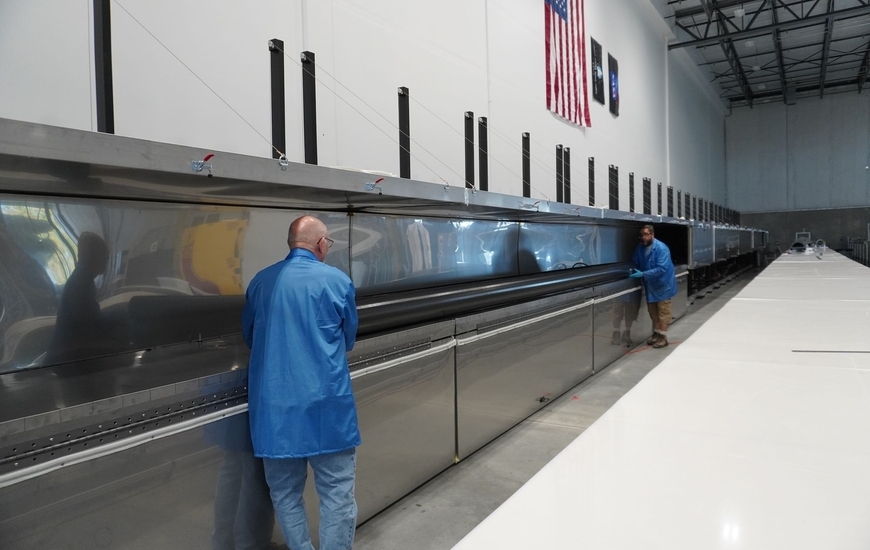


Opterus Research and Development has commissioned a new 140-foot, approximately 43-metre composite curing oven, significantly expanding its manufacturing capability for lightweight, high-performance structures used in next-generation spacecraft.
The new system will enable the production of composite booms more than 38 metres long, increasing the company’s previous long-boom capability by around 14 metres. Its larger cross-section will also accommodate wider boom geometries and potentially allow multiple components to be processed simultaneously.
The investment supports Opterus’ transition from deployable-structure research and development to the manufacturing and delivery of flight hardware for commercial, civil and defence space customers. The company is already supporting programmes involving solar arrays in the 20–100 kW range, where larger deployed surfaces must be achieved without a proportional increase in launch mass and stowed volume.
One of Opterus’ core technologies is the Trussed Collapsible Tubular Mast (TCTM), a deployable architecture designed to combine compact stowage, low mass and high stiffness after deployment in orbit.
The new oven also provides improved thermal uniformity, programmable cure profiles and calibrated process monitoring, helping deliver repeatable geometries and consistent mechanical performance for very large composite structures.
The system complements an existing 90-foot curing oven and a 20-by-20-foot walk-in oven used to manufacture composite booms, hinges, antenna reflectors, solar-array structures and other deployable space hardware.
One of the most advanced applications of the TCTM architecture is also linked to a future NASA solar-sail mission, for which Opterus is developing a variant incorporating 30-metre composite booms to deploy and support the sail membrane.
The expansion highlights the growing role of high-strain composites in a new generation of space structures designed to launch in highly compact configurations and deploy to much larger dimensions once in orbit.
-

-
29 October 2026