






by Ana PAVLOVIC*, Carlo SANTULLI**, Cristiano FRAGASSA * **
Polymers and metals have always been perceived as somewhat antagonistic materials. Metals have traditionally been the backbone of structural engineering: robust, reliable, easily workable, and recyclable. With the advent of engineering polymers and, subsequently, fiber-reinforced composites, the landscape has changed.
Polymers have progressively replaced many metal alloys thanks to their low weight, corrosion resistance, design freedom, and competitive costs. When superior mechanical properties were required, the integration of technological fibers-glass, carbon, aramids - has allowed for specific performance often superior to that of traditional metals.
In many sectors, from automotive to aerospace, polymer composites have thus "invaded" the industrial landscape, proving in just a few decades to be effective and high-performance alternatives. However, the very characteristics that made them successful-high strength, chemical stability, and irreversible cross-linking of thermoset matrices-now represent one of the main obstacles to their environmental sustainability. The topic of the circular economy and the recyclability of composites is complex and still the subject of intense scientific debate.
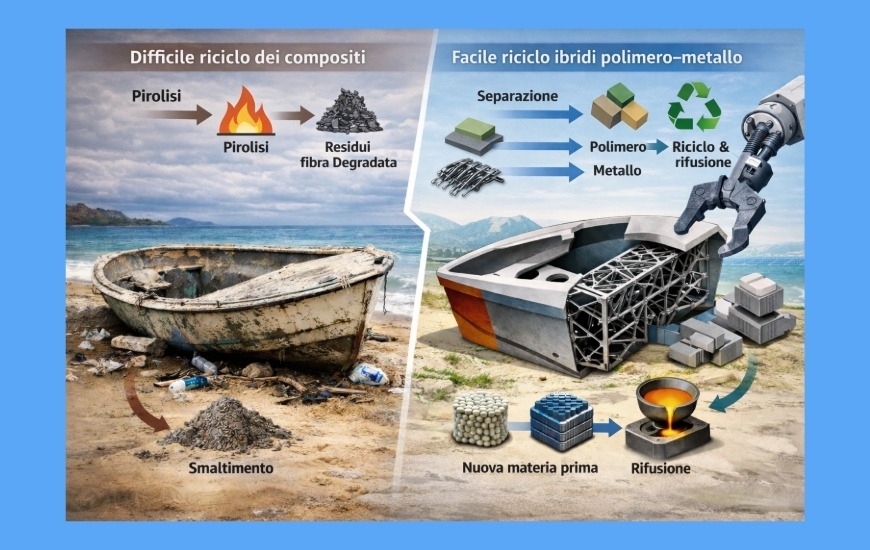
One of the most common processes for composite recovery is pyrolysis, which allows the polymer matrix to be thermally degraded in the absence of oxygen. In simple terms, the resin-often derived from petroleum-is "burned" and used as an energy source to sustain the process itself. However, the energy efficiency is not sufficient to generate a real surplus, as occurs in waste-to-energy plants; at best, the waste is eliminated and the fibrous fraction is recovered. However, the quality of the recovered fibers remains an open question: glass and carbon can undergo thermal and mechanical degradation that limits their structural reuse.
Even when technically reusable, they are often used in less noble forms than their original application, constituting a clear case of downcycling. Furthermore, considering that the predominant portion of the composite is composed of matrix and that the commercial value, for example, of glass fiber, is relatively low, the economic and environmental impact of recovery remains modest. In concrete terms, the disposal of one of the numerous medium or small fiberglass hulls can involve costs in the order of tens of thousands of euros, a circumstance that ends up encouraging their illegal abandonment along the coasts.
Faced with these critical issues, a possible conceptual alternative is emerging: no longer polymers reinforced exclusively with high-performance fibers, but "hybridized" polymers, reinforced with metal inserts and architectures. Metal, unlike fibers embedded in cross-linked matrices, is intrinsically recyclable, remeltable, and reintroduced into established production cycles. Structural integration between metal and polymer could therefore open up new prospects for a circular economy, with systems designed from the outset for easier separation, higher-value recovery, and greater compatibility with existing recycling chains. From this perspective, the collaboration between metal and polymer is no longer antagonistic, but complementary, and potentially more sustainable in the long term.
However, there are many obstacles to overcome: for example, it is necessary to rethink the design of hybrid systems with a more functional approach (e.g., disassembly), develop controlled interfaces that allow for greater integration between very different materials, and define regulatory standards and dedicated recovery chains. Only by integrating recyclability criteria, material traceability, and life cycle assessment from the design stage will it be possible to transform polymer-metal hybrids into a real opportunity for the circular economy.
Further information
Pavlovic et al, 'Polymer–Metal Hybrid Composites: An Overview of the Role of Metal Architecture'
* University of Bologna
** University of Camerino
-

-
04 March 2026