




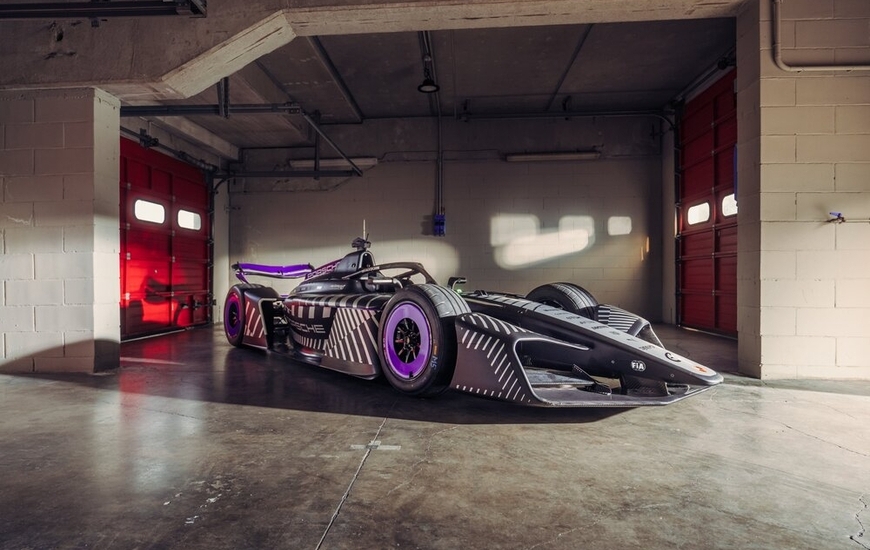


A new chapter in all-electric motorsport: with the 975 RSE, Dr. Ing. h.c. F. Porsche AG presents its future Formula E race car. The single-seater complies with the regulations for the fourth Formula E vehicle generation and will be used from next season onwards. The so-called GEN4 delivers the biggest performance leap in electric motorsport to date: 600 kW (816 PS) of power, permanent all-wheel drive, new tyres and significantly increased downforce bring Formula E into the slipstream of the fastest single-seater race cars worldwide.
“The GEN4 shows how far electric vehicles have evolved,” says Thomas Laudenbach, Vice President Porsche Motorsport. “When the championship started in 2014, every driver needed two cars per race. One battery alone was not enough to cover the full race distance. Those days are long gone. Since 2024, we have been developing a race car that puts us on the level of Formula 2 cars. EVs are not only catching up with the standards we are used to; their strengths are becoming increasingly evident – on the track and on the road.”
For the first time, aerodynamic downforce significantly increases the grip of Formula E cars. Together with new tyres and permanent all-wheel drive, this enables much higher cornering speeds. Olivier Champenois, Technical Project Leader Formula E at Porsche Motorsport: “Within roughly a decade, Formula E has become so fast that aerodynamic downforce is now a necessity. However, downforce always comes with drag and increases energy consumption. To maintain a strong focus on efficiency, we use two different aero packages with distinct bodywork components: a low‑downforce package with reduced drag for the races, and a high‑downforce package for qualifying, where energy consumption isn’t relevant. We are talking about up to 150 percent more downforce compared to the GEN3 Evo.”
Already in the current Formula E Porsche, the highly efficient GEN3 Evo-generation Porsche 99X Electric, drivetrain efficiency is well over 97 percent. From the battery to the wheels, less than 3 percent of the energy is lost – for example through friction in mechanical components. “As efficiencies approach perfection, other topics moved higher up the GEN4 development brief, including potential in terms of weight, durability and costs – similar to EVs for the road,” says Champenois. “The 975 RSE produces 71 percent more peak power than its predecessor. At the same time, we were able to reduce the weight of many parts. Although we are developing more components in-house for GEN4 than for GEN3, the total weight of our parts package was only allowed to increase by 5 kilogrammes.”
In Formula E, manufacturers primarily develop the technical components that are also relevant for electric road cars. In-house developments include operating software, pulse inverter, electric motor, gearbox, differential, drive shafts and other drivetrain components on the rear axle, as well as cooling, carrier and suspension components at the rear. With the introduction of GEN4, several additional components are added, including the DC/DC converter and the brake‑by‑wire system, further electronics and wiring looms, as well as control units for the hydraulic differentials. For cost reasons, the battery remains a standard-supplied component and may not be developed.
-

-
21 April 2026