




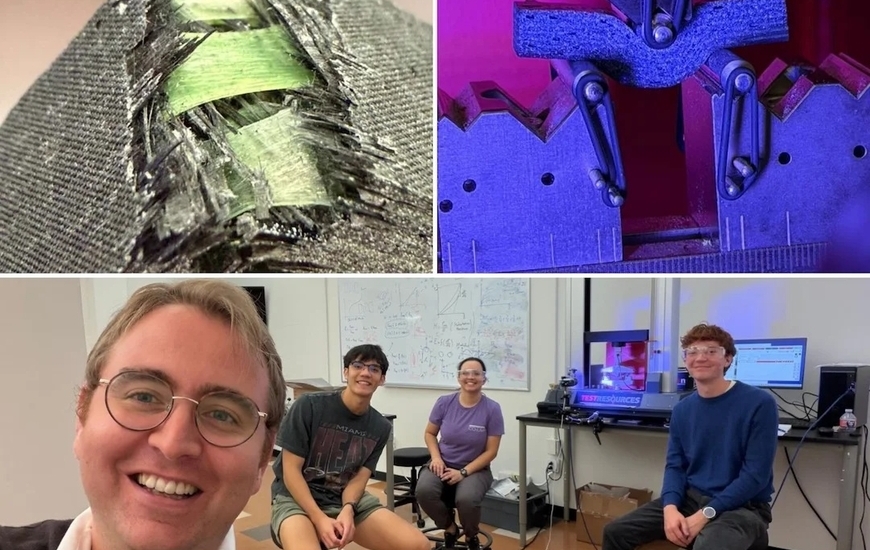


A group of Rice University students has transformed a classroom project into published scientific research by developing a new architecture designed to improve the damage tolerance of aerospace composite materials.
The study, published in Composites Part B, focuses on carbon fiber-reinforced polymer (CFRP) composites, materials widely used in aerospace thanks to their lightweight properties and high mechanical performance. Despite these advantages, CFRP structures remain vulnerable to sudden and brittle failure, a critical issue in safety-sensitive aerospace applications such as pressure vessels for propellant storage.
Instead of modifying the chemistry of the material, the Rice University team redesigned the internal structure of the composite. The researchers developed custom thermoplastic lattice interlayers inspired by nacre, or mother-of-pearl, strategically embedded between the stiff composite layers.
Unlike conventional soft interlayers that often weaken structures, the new architecture preserves structural load paths while enabling gradual damage propagation instead of catastrophic failure.
The project originated within the Rice University course “Composite Materials for Aerospace Structures” and was entirely conceived and executed by undergraduate and master’s students during a single academic semester. According to the researchers, the new architecture could pave the way for safer and more damage-tolerant aerospace composite structures.
-

-
08 May 2026