




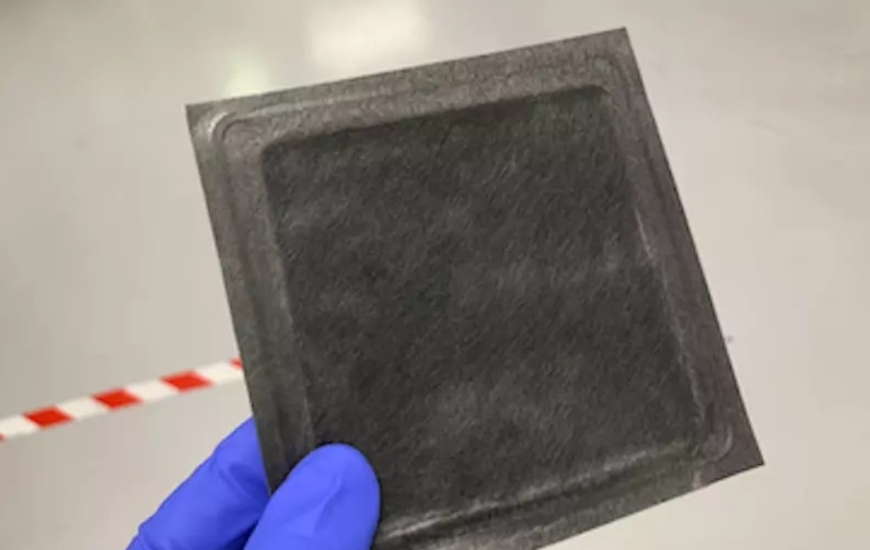


Sakuu has developed a new lithium-ion battery cell manufactured entirely through a dry process and reinforced with a carbon fibre veil, using its Kavian manufacturing platform. Unveiled on 13 October, the cell combines a polymeric current collector (PCC) with a carbon composite architecture designed to provide low weight, flexibility, electrical conductivity and structural strength.
The demonstrator is a fully functional 0.5 Ah cell, eliminating conventional metallic current collectors and using a process in which both the anode and cathode are completely dry printed. According to Sakuu, the PCC configuration also limits the risk of thermal runaway through its particular electrical architecture.
A key feature is the use of a carbon fibre veil. Thin polymer films used in current collectors can be prone to wrinkling, while carbon fibre adds strength and electrical conductivity. The fibres penetrate the current collector and are also embedded within the dry-powder anode and cathode layers, creating a reinforcing network while improving electrical contact between adjacent layers.
According to the company, this architecture could also open opportunities for structural batteries. Lightweight and conformable cells could eventually be integrated directly into aircraft, vehicles, wearable devices or other systems, allowing part of the structure itself to contribute to energy storage.
The Kavian platform eliminates liquid slurries, solvents and the associated drying stages used in conventional electrode manufacturing. Sakuu is developing the technology to reduce manufacturing complexity, energy consumption and waste while supporting industrial-scale production across different battery and supercapacitor chemistries.
The carbon fibre cell was produced and tested at Sakuu’s Silicon Valley R&D facility. For the composites industry, the development points to a new potential application in which carbon fibre is not only a structural material but also becomes part of the electrical and energy-storage architecture.
-

-
14 October 2026