




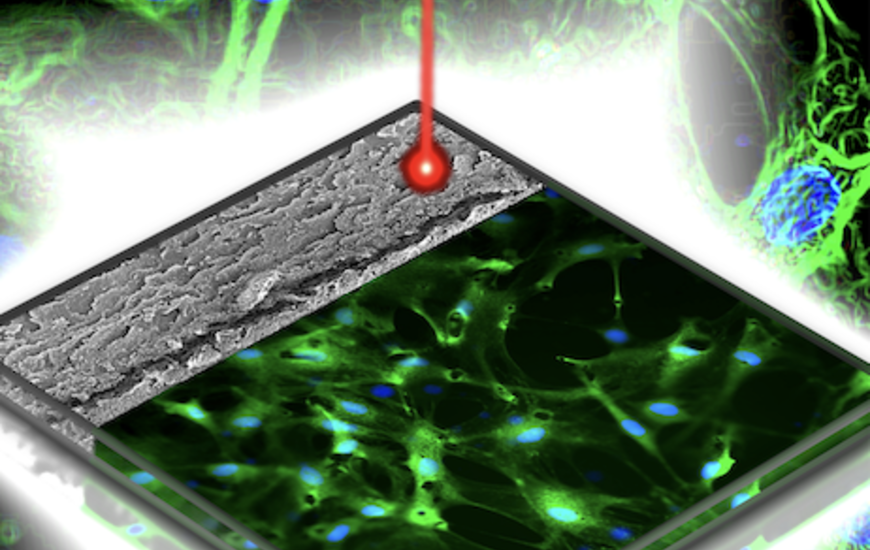


A team of researchers from the Institute for Organic Synthesis and Photoreactivity (Cnr-Isof) and the Institute of Nanostructured Materials (Cnr-Ismn) of the National Research Council of Italy, Ca’ Foscari University of Venice, the University of Ferrara, the University of Bologna and collaborating institutions has developed an innovative graphene-based bioelectronic platform that combines sustainable materials, advanced sensing capabilities, and neural stimulation in a single device.
Published in Advanced Materials, the study presents a biodegradable and biocompatible platform made of poly(lactic acid) (PLA) and graphene oxide, processed through a green, water-based manufacturing route and transformed into conductive devices by laser functionalization.
The resulting graphene-based electrodes offer a unique combination of properties: they can sensitively detect neurotransmitters and other biologically relevant molecules while also interacting with astrocytes, glial brain cells increasingly recognized as active modulator of brain function and dysfunction. The platform demonstrated excellent performance in the electrochemical detection of catecholamine neurotransmitters such as adrenaline, dopamine and noradrenaline, outperforming conventional commercial carbon-based electrodes while maintaining full biodegradability.
In parallel, the researchers showed that the same material can selectively modulate astrocyte calcium signaling through electrical stimulation. By tuning the properties of the laser-patterned graphene electrodes, they were able to control the intensity and dynamics of astrocyte responses, opening new opportunities for studying neuron-glia communication and developing future bioelectronic therapies.
The work represents a significant advance toward multifunctional and eco-sustainable neuroglial technological platform capable of both monitoring the bioactive molecule released in the brain and actively modulating cellular activity. By integrating sensing and stimulation within an advanced biodegradable platform, the study points toward a new generation of smart medical devices with a lower environmental footprint.
The work delivers a new class of sustainable neural interfaces at the intersection of materials science, nanostructured graphene synthesis, bioelectronics, neurotechnology and sustainable electronics. It demonstrates how materials processing parameters (e.g. laser fluence) can be used to tune and control electrical, structural, and electrochemical properties to co-design device functions in both electrochemical sensing and glial stimulation.
“The platform provides highly sensitive and selective electrochemical detection of neurotransmitters, offering new opportunities for real-time biochemical monitoring,” said Chiara Zanardi (Cnr-Isof).
“By enabling selective control of astrocyte calcium signaling, this technology offers a powerful new tool to investigate the active role of astrocytes in brain function and disease and aligns with international efforts and strategies to develop sustainable electronics targeting astrocytes at the center of future therapies for neurological disorders.” said Valentina Benfenati (Cnr-Isof).
“This work demonstrates how graphene nanomaterials, advanced laser manufacturing, and sustainable composites can be combined to deliver next-generation bioelectronic functions, paving the way for environmentally responsible neuroglial technology,” said dr. Emanuele Treossi.
The work is supported by PNRR MUR project ECS_00000033_ECOSISTER, National Recovery Found PRIN PNRR-NANODYN, AFOSR ASTROTALK. Astrocyte research is part of the strategic activities of the “Advanced Materials and Biophysics” working group of the Italy–United States Joint Commission for Scientific and Technological Cooperation between the Italian Ministry of Foreign Affairs and International Cooperation and the U.S. Department of State, co-chaired by dr. Luigi Ambrosio (CNR) and Sofi Bin-Salamon (US-AFOSR)
The study was published in Advanced Materials, with Alessandra Scidà, Giulia Cazzador and Roberta Fabbri contributing as co-first authors. The work has also been selected for one of the covers of Issue 58 of the journal and is available in open access at the link below.
In the image: Illustration of the sustainable graphene-based neuroglial platform
-

-
01 September 2026