




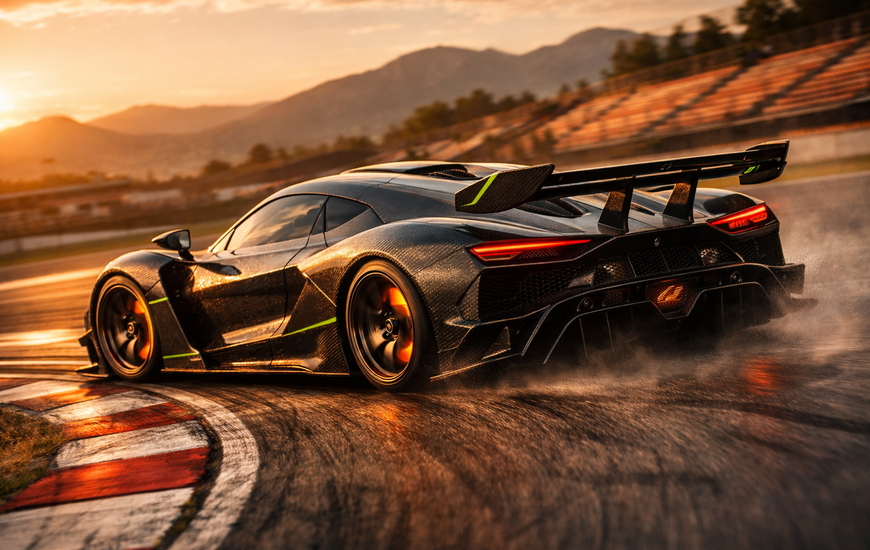


In the hypercar segment, ultimate performance has long been associated with advanced composite materials, especially carbon fiber. Today, alongside power, stiffness and weight reduction, a new strategic parameter is gaining relevance: sustainability.
Premium automotive brands are increasingly investing in solutions that combine structural performance with lower environmental impact across the entire vehicle life cycle. Recycled carbon fiber is emerging as one of the most promising innovations. These fibers are recovered from production scrap or end-of-life components and reprocessed for use in structural or semi-structural parts. Although they may not always match the properties of virgin fiber in primary load-bearing components, they offer a valuable balance between mechanical performance and environmental responsibility.
Another key development concerns polymer matrices, the resins that bind the fibers together. Bio-based resins, partially derived from renewable sources, help reduce reliance on fossil-based raw materials while maintaining high thermal and mechanical resistance. At the same time, the adoption of thermoplastic matrices - materials that can be remelted and reshaped - opens new perspectives in terms of recyclability and shorter production cycle times compared to traditional thermoset systems.
In electric hypercars, composites play a crucial role in the design of lightweight battery enclosures. Lower mass translates into improved driving dynamics and extended range, offsetting the weight of battery packs. CFRP (Carbon Fiber Reinforced Polymer) structures also provide high torsional stiffness and effective energy absorption in crash scenarios.
The new technological luxury therefore goes beyond exposed carbon aesthetics. It involves responsible engineering, material traceability and LCA (Life Cycle Assessment), a methodology used to evaluate the environmental impact of a product throughout its entire life cycle.
Sustainable hypercars are becoming advanced laboratories for the broader automotive industry. Technologies developed for limited series and high-performance models can progressively move into wider premium production, redefining the relationship between innovation, exclusivity and environmental responsibility.
The editorial team
-

-
25 February 2026