






In recent years thermoplastic composite materials have emerged as one of the most promising technologies in the aerospace sector. Traditionally, composite aerostructures are manufactured using thermoset matrices such as epoxy resins. While these materials provide excellent structural performance, they also present limitations in terms of production speed and end-of-life recyclability.
Thermoplastic composites, by contrast, use polymer matrices that can be reheated and reshaped. This means that the material can be processed faster and potentially recovered at the end of its lifecycle, making the manufacturing process more sustainable.
One of the main advantages of thermoplastic composites is production speed. Unlike thermoset materials, which require long curing cycles in autoclaves, thermoplastics can be consolidated and formed in much shorter times. This aspect is particularly attractive for the aerospace industry, which is seeking to increase aircraft production rates.
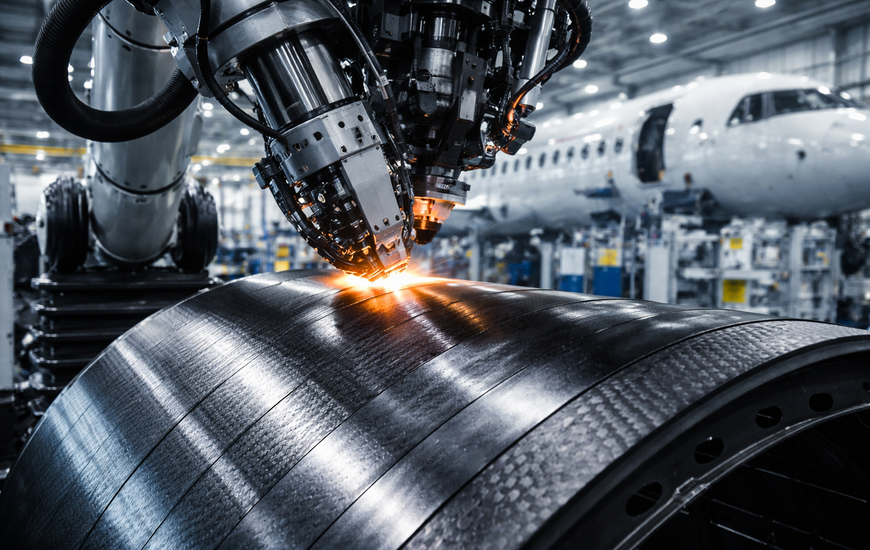
Another important benefit is the possibility of highly automated manufacturing processes. Technologies such as Automated Fiber Placement (AFP) and thermoforming allow the production of complex structural components with high repeatability and controlled costs. These processes are already used in several aerospace programs, especially for fuselage panels, secondary structures and interior components.
From a performance perspective, carbon-fiber reinforced thermoplastic composites offer high resistance to fatigue and impact loads. In addition, structural joints can be achieved through thermoplastic welding, eliminating rivets or adhesives and improving structural continuity.
Sustainability is another strategic factor. Thermoplastic composites can be shredded and remelted to produce new reinforced materials. This feature is particularly relevant for the aerospace industry, which is increasingly developing circular economy strategies to manage end-of-life composite structures.
Major aircraft manufacturers and material suppliers are investing heavily in this technology. Airbus, Boeing and several tier-one suppliers are developing structural components based on advanced thermoplastics such as PEEK, PEKK and PPS reinforced with carbon fiber.
Looking ahead, thermoplastic composites could represent a key step toward a new generation of lighter, more efficient and more sustainable aerostructures. The combination of automated manufacturing processes, shorter production cycles and improved recyclability makes this technology particularly attractive for an aerospace industry that must increase production rates while reducing its environmental impact.
In the coming years, the main challenge will be to move these solutions from niche applications to large-scale industrial platforms capable of reshaping aerospace manufacturing models.
In the image: Industrial robot performing automated placement of thermoplastic carbon-fiber tapes during the manufacturing of an aerospace structure (ph. AI)
The editorial team
-

-
08 April 2026