




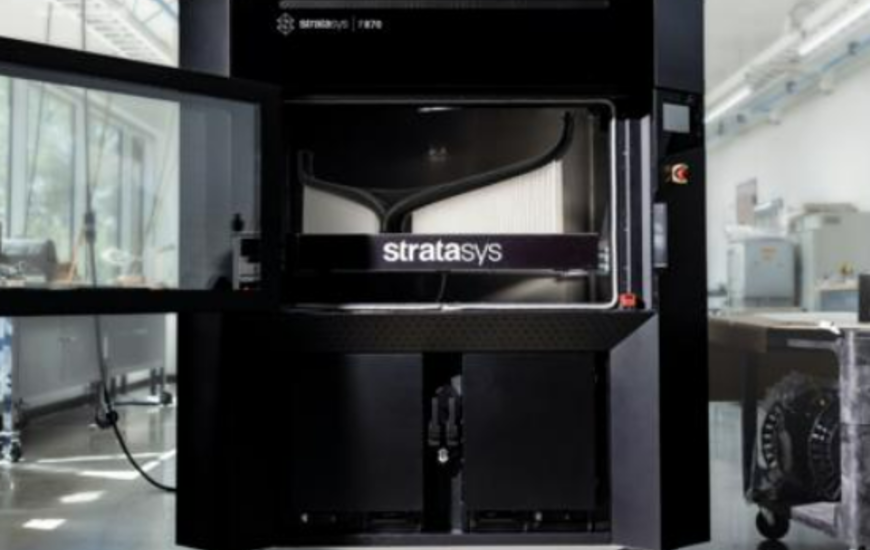


Toyota Production Engineering and Rivian have adopted the new Stratasys F870, an industrial additive manufacturing platform designed to expand the use of 3D printing directly on the factory floor. The system specifically targets applications including tooling, fixtures, manufacturing aids and functional components for production environments.
Officially introduced on 9 September, the F870 provides a 1,000 x 610 x 610 mm build volume and a fully heated chamber, allowing manufacturers to produce large-scale tooling or multiple components in a single build.
Of particular interest to the composites industry is its compatibility with FDM Nylon 12CF, which combines Nylon 12 with chopped carbon fibre to provide high stiffness and a strong strength-to-weight ratio. Stratasys targets the material at applications including production tooling, structural fixtures and robotic end-of-arm tooling.
The approach is intended to replace conventionally CNC-machined or metal tooling in selected applications. Robotic end effectors, for example, can be manufactured using carbon fibre-reinforced material to reduce weight compared with metal alternatives while providing greater freedom to optimise their geometry.
Toyota Production Engineering and Rivian will use the new platform within their respective manufacturing strategies, helping demonstrate its potential for industrial-scale deployment. The F870 has been designed specifically for factory applications where lead times, tooling customisation and in-house production capabilities can have a direct impact on manufacturing efficiency.
The increasing use of carbon fibre in industrial additive manufacturing therefore highlights a broader trend: 3D-printed thermoplastic composites are moving beyond prototyping to become functional tools and components used directly on production lines.
-

-
15 September 2026